
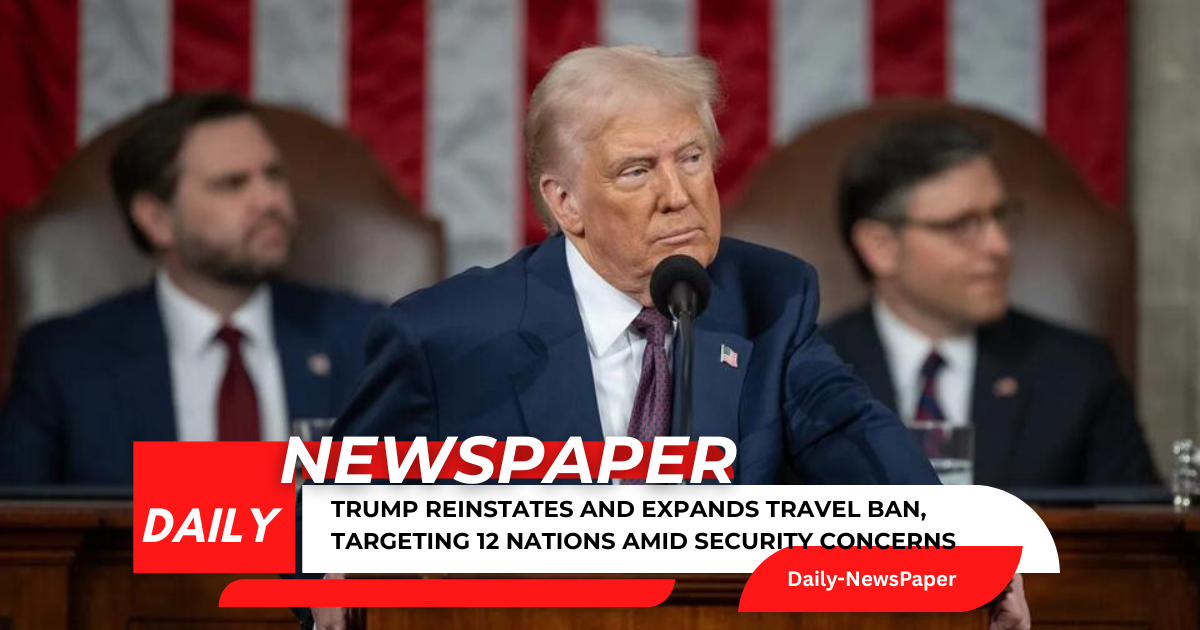
DAKAR, Senegal — In a sweeping policy revival that echoes one of the most controversial decisions of his first term, President Donald Trump has banned citizens of 12 countries—mostly in Africa and the Middle East—from entering the United States, citing national security concerns and risks of visa overstays.
The new travel ban, which takes effect Monday at 12:01 a.m., affects nationals from Afghanistan, Myanmar, Chad, the Republic of Congo, Equatorial Guinea, Eritrea, Haiti, Iran, Libya, Somalia, Sudan, and Yemen. In addition, the administration is restricting entry for citizens of Burundi, Cuba, Laos, Sierra Leone, Togo, Turkmenistan, and Venezuela who are currently outside the U.S. and do not possess valid visas.
The policy, introduced through a January 20 executive order, mandates the Departments of State and Homeland Security, alongside the Director of National Intelligence, to identify countries with “hostile attitudes” toward the U.S. or those with “deficient” security screening processes.
“We don’t want them,” Trump said in a video message, referencing a recent terror attack in Boulder, Colorado, perpetrated by an Egyptian national who overstayed a tourist visa—though Egypt is not on the restricted list.
Who is Exempt
Despite the broad restrictions, several groups are exempt from the ban:
- U.S. lawful permanent residents from the affected countries;
- Dual nationals with U.S. citizenship;
- Athletes participating in major international events;
- Afghans with Special Immigrant Visas;
- Iranians fleeing religious or ethnic persecution;
- Long-serving foreign employees of the U.S. government and their families;
- Refugees already granted asylum;
- Visa applicants with immediate U.S. family ties;
- Diplomats, U.N. delegates, NATO representatives, and adopted children of U.S. citizens.
Political and Global Reactions
Human rights and immigrant advocacy organizations swiftly condemned the measure. Oxfam America called the ban “ideologically motivated,” while the Council on American-Islamic Relations labeled it “overbroad and unnecessary.”
The African Union Commission expressed “deep concern” about the ban’s impact on education, commerce, and diplomacy. It urged Washington to pursue a more consultative approach with affected nations.
A New Chapter in Immigration Policy
This latest move marks a dramatic escalation of Trump’s already aggressive immigration agenda since returning to office. It also signals a revival of his 2017 “Muslim Ban,” which was eventually upheld by the U.S. Supreme Court in 2018 after multiple legal challenges.
However, the 2025 version is broader in scope, applying to a more diverse range of countries and including exceptions designed to minimize disruption to U.S. government operations, international diplomacy, and certain humanitarian categories.
The administration stated that the list of affected countries may evolve, with nations removed if they improve security protocols or cooperate on immigration enforcement—and others added “as threats emerge around the world.”